
For parents considering a boarding school for their young daughter, security is not a checkbox-it is the foundation of trust. The question is no longer whether a campus has boundary walls or CCTV cameras, but whether safety is thoughtfully integrated into the everyday life of a child. As boarding education expands to include primary-age girls, educators and child-development experts are urging parents to look deeper into what “real security” actually means.
Traditional security measures serve an important purpose, but they address only external risks. The more complex challenge lies within the campus: ensuring children are emotionally secure, supervised during transitions, and supported by adults they trust. For girls aged eight to eleven, safety is inseparable from predictability, familiarity, and human connection. A campus can be heavily guarded and still feel unsafe to a child if routines are unclear or caregivers are distant.
Experts increasingly agree that real security rests on five interconnected pillars:
- Consistent adult presence, especially female caregivers in residential spaces
- Predictable daily routines that reduce anxiety and uncertainty
- Controlled but open campus movement, preventing isolation without creating confinement
- Emotional safety systems, including counselling and daily reassurance
- Values-driven discipline, where behaviour is guided rather than punished
A significant but often overlooked factor is emotional vulnerability. Many safety incidents stem not from external threats but from moments of distress-homesickness, fear, or confusion. Schools that anticipate these moments and build systems around them are far better equipped to protect young boarders. This is why modern residential schools now emphasize relational safety: ensuring every child is known, seen, and supported.
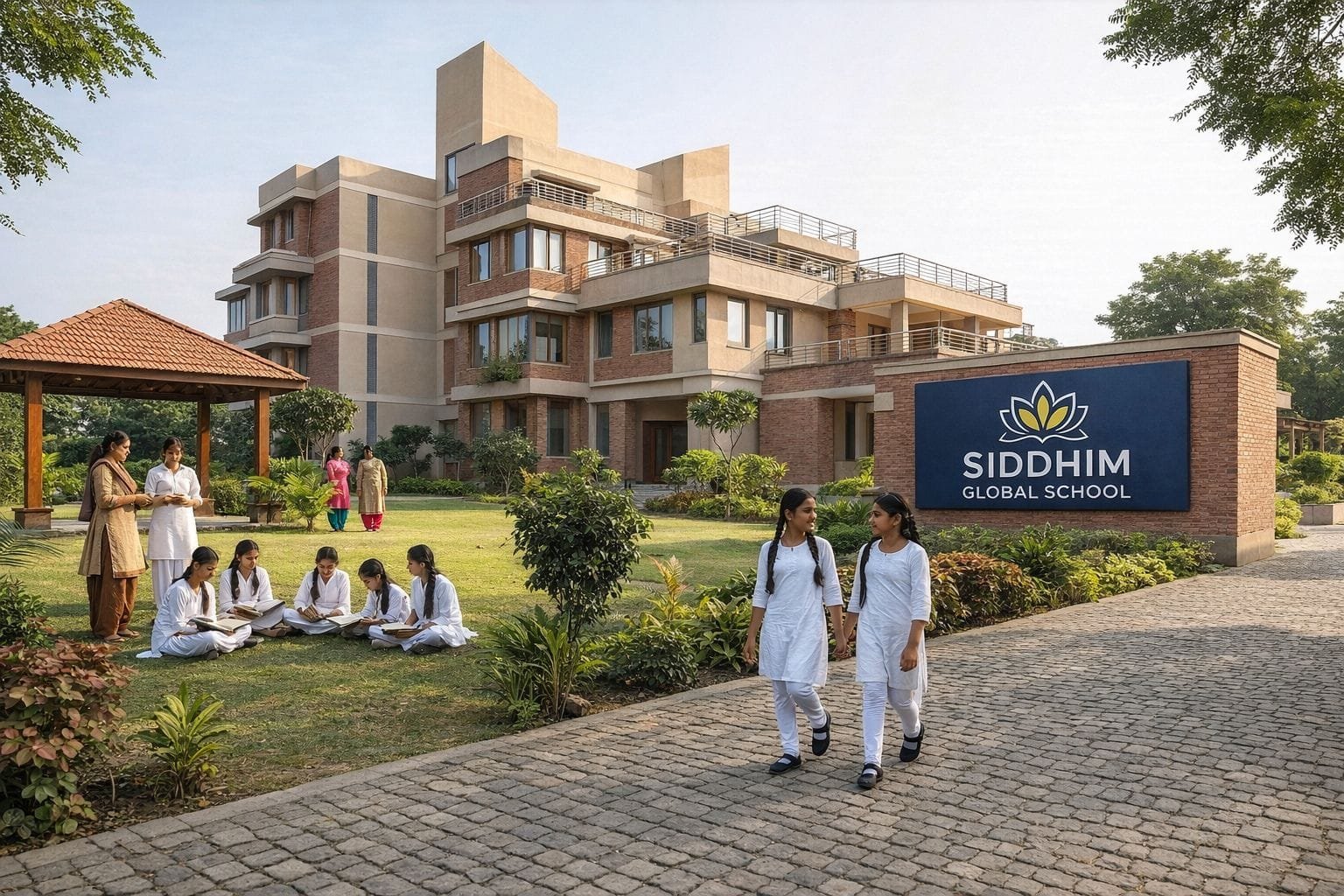
Siddhim Global School, a fully residential girls’ school near Jaipur, follows what it describes as a “human-first security model.” Instead of treating safety as a standalone department, the school embeds it into daily life. Teachers, caregivers, and wardens maintain a constant presence, especially during high-risk periods such as early mornings, post-activity hours, and nights. Dormitories are supervised not only for order but for emotional well-being, ensuring that children feel comforted rather than monitored.
A defining feature of Siddhim’s approach is its emphasis on rhythm. Children follow clearly structured days-waking, learning, playing, eating, and resting at predictable times. These routines act as emotional anchors, helping young girls feel grounded even while living away from home. The school also integrates mindful practices, encouraging awareness in simple daily habits like eating, walking, and resting.
Parents evaluating boarding schools should therefore ask critical questions: Who comforts my child when she is scared at night? Who notices if she becomes unusually quiet? How does the school prevent unsupervised moments during transitions? The answers to these questions reveal far more about safety than any brochure.
In today’s context, real security is not about imposing control-it is about creating an environment where a child can relax, trust, and grow. Schools that understand this distinction are setting new standards in residential education.
Contact & Admissions Enquiries
Siddhim Global School
NH-48, Jaipur–Ajmer Highway, Dudu, Rajasthan
Parents seeking further information or admission guidance may connect with the school through the following official channels:
📞 Admissions Helpline: +91 94617 08177
💬 WhatsApp Admissions Desk: https://wa.link/ajsuih
🌐 Official Website: https://www.siddhimglobalschool.org
Admissions Open for Academic Year 2026–27
(Residential Programme for Girls – Grades 3, 4, 5 & 6)

